
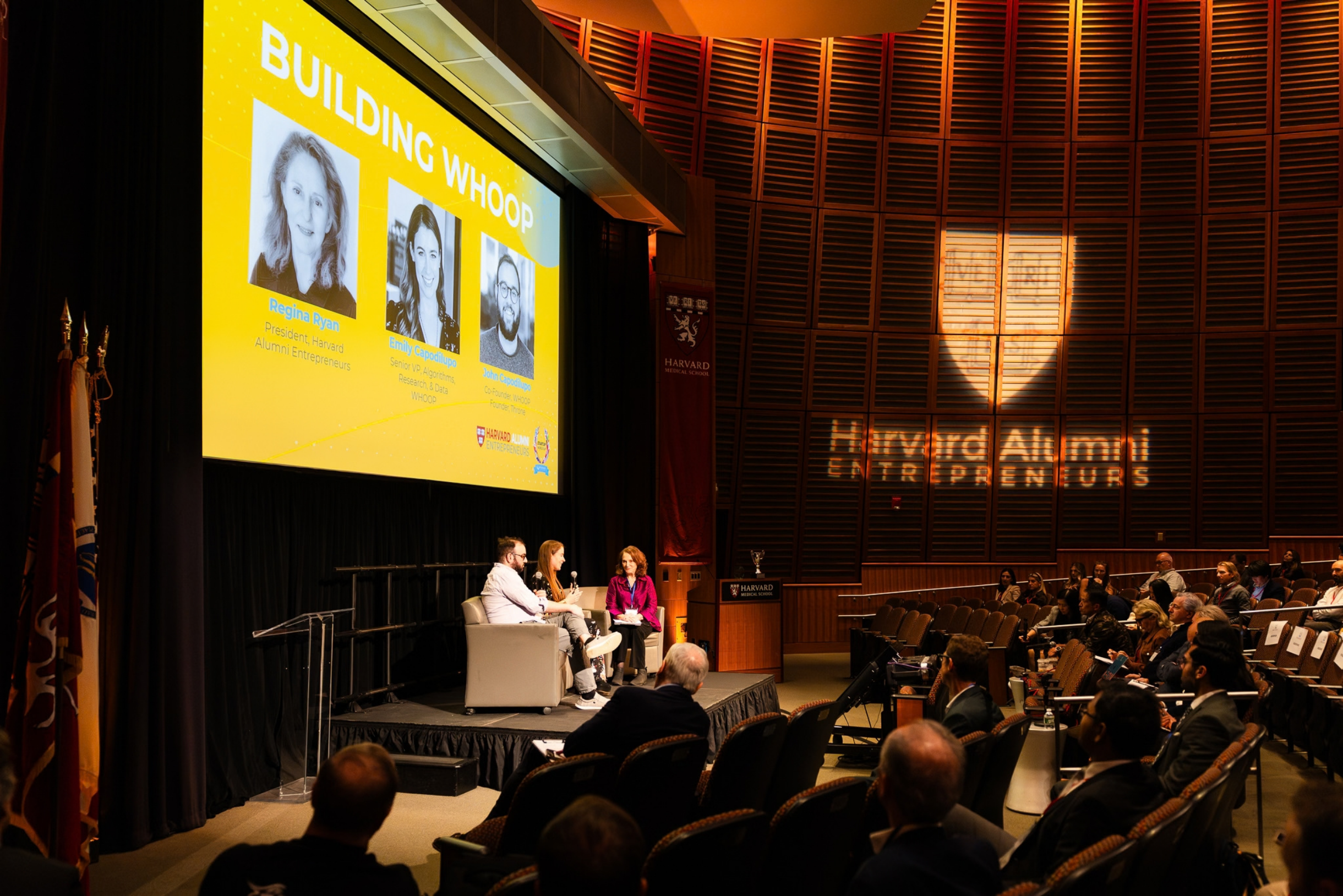
From Harvard squash courts to a multibillion-dollar company, WHOOP’s founders reveal the pivots, near misses, and relentless focus behind their success.
WHOOP began with a problem familiar to competitive athletes: training harder did not always mean performing better. Harvard squash captain Will Ahmed wanted to know when to push and when to recover. Fellow student John Capodilupo saw a larger opportunity: while data was transforming other fields, people still knew remarkably little about what was happening inside their own bodies.
The missing piece was understanding recovery. Emily Capodilupo, then conducting sleep research at Brigham and Women’s Hospital, brought a scientific perspective to the same question. Together, those insights helped shape WHOOP: a device and data platform intended to make the body’s signals useful in everyday decisions.
The idea was ambitious. Turning it into a business required much more than technology. Harvard athletes became early testers; professional teams proved to be a difficult market; investors were skeptical; and the founders eventually made a high-stakes shift from selling hardware to selling ongoing value. At the Harvard Alumni Entrepreneurs Startup World Cup Regional, John and Emily joined Regina Ryan to discuss the decisions that made the difference.
Will’s experience as a squash player was the starting point. How did that become a larger idea about data and human performance?
John: Back then, “wearable” wasn’t even a word yet. Will was a very competitive athlete, and he would always overtrain. He wouldn’t take the rest days he needed. He was like, “I need some kind of data to tell me when my body is ready.” At the same time, big data was becoming a buzzword. We had big data on weather, servers and traffic patterns—but not on our bodies. It was still just five data points a year when you went to the doctor.
Emily, where did sleep research fit into that original idea?
Emily: Will interpreted motivation as more push-ups, more laps, more squash, and he ended up having a horrible season because of it. What he really needed was more sleep, and nobody was telling him that. I was studying sleep less than a block from here. Sleep studies cost something like $2,000 per person per night, so even a tiny study takes a million dollars. We were all living this problem from different angles. The fact that WHOOP didn’t exist was a problem in our lives.
How did you find your first users, and what did Harvard make possible?
Emily: We were incredibly lucky to be at Harvard. Will had been captain of the squash team, and that gave us connections to the athletic world. Our first 10 clients were 10 Harvard athletic teams. We’d buy them pizza in exchange for data and feedback. For the cost of two pizza pies, we got enormous amounts of data. Now we pay people about a hundred bucks to come answer questions in our lab. You can’t quite scale pizza. A lot of the squash players had played when Will was captain. Of course you’re going to do that guy a favor. The lesson is to think about what you have access to for free, and who wants you to succeed as much as you do.
How did those early experiments lead to bigger opportunities?
Emily: We started with one problem for one user and solved it deeply. Michael Phelps was one of our first five users. LeBron James was in the first 20. They were like, “This is the information I never had.” And from that, all of a sudden, you get permission to go big.
You had enthusiastic early users. Why were investors still skeptical?
John: Trying to build a hardware business back then, most VCs didn’t even take meetings with us. Add healthcare and FDA concerns on top of that. What let us believe was engagement. Our first paid users used it religiously. We had 82% daily active over monthly active users—higher than Snapchat at the time. We knew people really cared about it.
And investors also pushed you to leave Boston?
Emily: We had a ton of pressure to move to New York or Silicon Valley. VCs would say, “We’ll talk if you move, but you’ll never succeed in Boston.” We are very proud to have proven them wrong.
You had elite athletes using WHOOP, but the original market was difficult. What wasn’t working?
John: We didn’t start as a consumer company. We sold to colleges, pro teams, Olympians and the military. Pro athletes turned out to be a really difficult market. There’s so much tension between the athlete and the team over sharing physiological data. We could do one-off deals with every team, but that’s a consulting company, not a real company. That was our first existential challenge.
And there were moments when survival itself was in question?
Emily: It’s easy to sit here now and say it was great the whole time. It was not. There were multiple times where we almost ran out of money, and you sit around a scary table and ask, “Are we going to survive this?” If you’re in one of those moments, you’re not alone.
What did the team-versus-athlete tension reveal about who the real customer was?
John: Athletes don’t share data with their coach, because the coach decides whether to cut them. But if their personal trainers fell in love with WHOOP, they’d put it on their athletes. We realized we were building a consumer business all along. One NFL deal sounds like hundreds of straps, but it’s way easier to do 600 individual sales.
Then came the business-model decision. Why move away from selling a $500 device?
John: WHOOP started as a one-time $500 purchase. We were raising our Series C, Fitbit was crashing in the public markets, Jawbone went out of business, and wearables weren’t cool anymore. People would use other wearables for 90 days and hang them up. With WHOOP, people kept using it, but the price drove them away. Cutting it to $250 would have hurt the brand. The value was in the data, not the hardware. So overnight, it became $30 a month. We really bet the whole company on it.
How did you respond when larger competitors entered the category?
Emily: When Apple announced its watch, everybody told us, “You’re toast.” Today knockoffs come out called the “WHOOP killer.” But it pushes us to ask what our moat is, and whether to go head to head or win the lane that’s still open.
Was there another turning point that changed how people understood the product?
Emily: I’ll pick COVID. We noticed respiratory rate behaving oddly about three days before symptoms appeared. We published by June 2020 and worked with the FDA. Then the PGA reopened, and Nick Watney tested negative and was cleared to play. The next morning his WHOOP respiratory rate was elevated. He demanded a retest, and it was positive. The headlines said “WHOOP saved the PGA.” That moved wearables from fitness products to health products. We now have FDA-cleared features. In five or ten years, I think wearables will be covered by insurance, and talking about your data with your doctor will be totally normal.
For founders with an idea, a small team and some traction, what should they obsess over --and what should they ignore?
John: Quality. That goes against “move fast and break things,” but it’s worth taking the extra month. Quality is not something you can sprinkle in at the end. It has to be baked into the whole process. In today’s world of AI slop, quality is going to be the big differentiator.
And what about the pressure to keep adding products and chasing new opportunities?
Emily: You’re much better off fully solving one problem than half solving 20. While we were raising our Series D, one investor made the deal contingent on us building a product for racehorses. There are less funny versions of that all the time. For about four years, we did three things: sleep, strain and recovery. That was it. Especially when you’re fundraising, it’s easy for people to be good-idea fairies. Understand your customer, obsess over what they care about, and truly solve one problem before moving on.